



By Jeremiah Gora
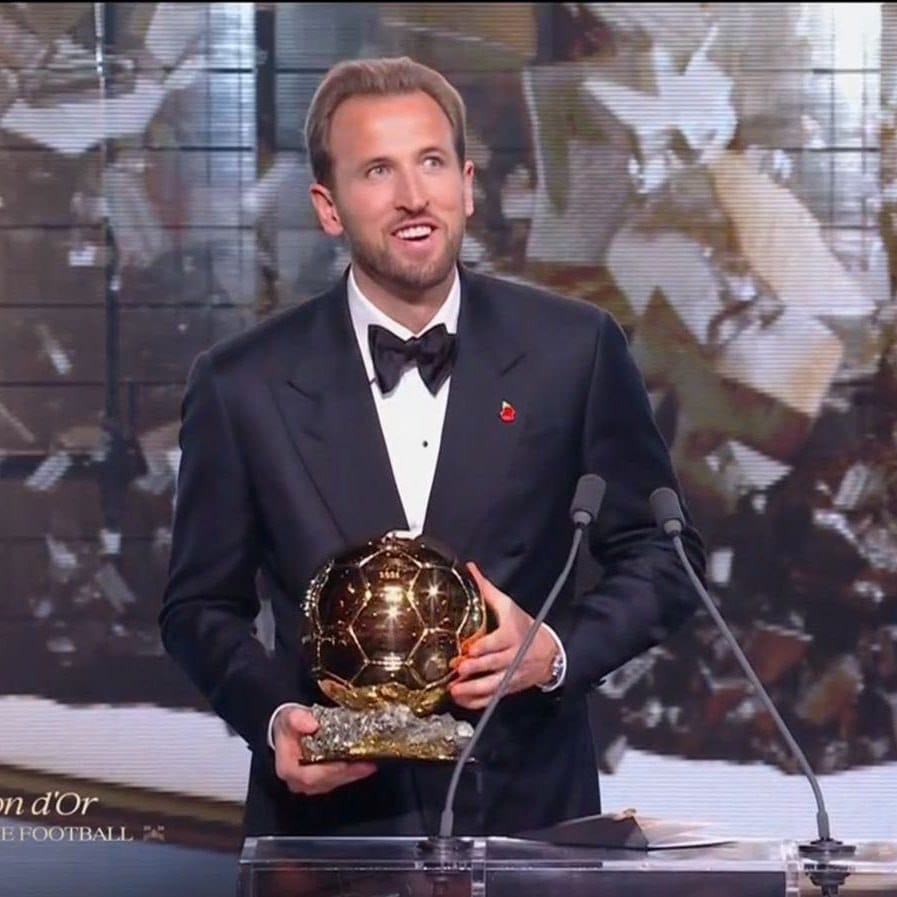
England captain Harry Kane completed one of the defining chapters of his career on Monday night when he was crowned the 2026 Ballon d’Or winner, becoming the first Englishman in 25 years to claim football’s most prestigious individual prize.
Kane, 33, was rewarded after a remarkable 2025/26 campaign in which he scored 73 goals in 65 appearances for Bayern Munich and England, including 61 for the German champions and 12 for the Three Lions. His performances helped Bayern secure the Bundesliga, DFB-Pokal and Franz Beckenbauer Supercup, while he scored six goals as England finished third at the 2026 FIFA World Cup.
The Bayern striker defeated France captain Kylian Mbappe and Spain’s teenage sensation Lamine Yamal to claim the men’s award at the London Palladium, with the ceremony marking the 70th anniversary of the Ballon d’Or and being staged in London for the first time as a tribute to the inaugural winner, England’s Sir Stanley Matthews.
Kane’s triumph ended England’s 25-year wait since Michael Owen won the award in 2001 and made him only the fifth Englishman to receive the honour after Matthews, Bobby Charlton, Kevin Keegan and Owen.
“It was the best season of my career without a doubt,” Kane said after receiving the award.
He also paid tribute to those who had helped him reach the summit, saying: “To score this amount of goals is a total team effort.”
For Kane, the Ballon d’Or represents more than recognition for a prolific goalscoring season.
It provides the most significant individual accolade of a career that has often been judged against the absence of major international and European trophies.
The England captain endured a Champions League final defeat with Tottenham Hotspur in 2019 and suffered European Championship final defeats with England before moving to Bayern Munich in 2023.
His individual numbers, however, have remained extraordinary.
He is England’s all-time record goalscorer and Tottenham’s record goalscorer, and his 2025/26 campaign elevated him from one of the world’s elite strikers to the holder of the game’s biggest individual prize.
The award also came at a significant moment for English football.
England’s third-place finish at the 2026 World Cup was the country’s best World Cup performance since its 1966 triumph, while Kane’s six goals made him one of the tournament’s leading performers.
Kane described the significance of winning the trophy on home soil.
“I love to represent my country and to bring this trophy back to them and have an English winner I think is something that’s really, really special, especially here in London,” he said.
While Kane ended England’s long wait, Spain continued its extraordinary domination of the women’s award as Alexia Putellas won the Women’s Ballon d’Or for a record-equalling third time.
Putellas, 32, previously won the award in 2021 and 2022 before Aitana Bonmatí took the honour three consecutive times from 2023 to 2025.
Her victory therefore means that a Spanish player has won the Women’s Ballon d’Or for six consecutive years, with Putellas and Bonmatí accounting for all six awards.
Putellas’ latest success came after a standout season with Barcelona, during which the club won four trophies, including the Women’s Champions League.
She scored seven goals and provided seven assists during Barcelona’s European campaign and was named UEFA Women’s Champions League Player of the Season.
She subsequently moved to London City Lionesses ahead of the 2026/27 campaign.
For Putellas, the award represented a return to the top after injury setbacks had disrupted her career and allowed Bonmatí to take over as the dominant figure in women’s football.
Speaking after receiving the trophy, Putellas said she was “speechless” and credited her teammates for a season in which Barcelona overcame injuries and other obstacles.
She later delivered a message to aspiring footballers around the world:
“To all the boys and girls in the world, if you want to play football, play football, it doesn’t matter if you’re a boy, a girl, or where you come from.”
She urged young players to believe in themselves and pursue their dreams with passion.
Putellas also described the latest award as particularly special because of what Barcelona achieved during the season.
“The way they played last season and won, giving so much happiness to their supporters… it’s the best way to finish,” she said.
Putellas’ triumph was only one part of a remarkable Spanish night.
Spain dominated several of the major individual categories, underlining the depth of the country’s current football production.
Yamal won the Men’s Young Talent of the Year award for the third consecutive year, while Barcelona’s Vicky López won the Women’s Young Talent prize.
Spain goalkeeper Unai Simón was named Men’s Goalkeeper of the Year and Barcelona’s Cata Coll won the women’s equivalent.
Spain coach Luis de la Fuente was named Men’s Coach of the Year, while Barcelona’s Pere Romeu won the women’s coaching award.
Putellas completed the Spanish sweep at the top of the women’s game, while Barcelona was named Women’s Club of the Year.
The concentration of Spanish winners was particularly striking because it extended beyond one generation.
Putellas represents the established generation, Yamal the emerging men’s superstar and López the next wave of young talent, while the success of Barcelona’s women’s team continues to provide the platform for many of Spain’s leading players.
The results demonstrate the strength of Spain’s football system at both club and international level.
The ceremony also carried historical significance beyond the individual winners.
The 2026 edition was the 70th Ballon d’Or, an award first presented in 1956 to Stanley Matthews.
Moving the ceremony from its traditional Paris setting to London was intended to honour Matthews, whose victory launched the history of the prize.
The men’s Ballon d’Or remains the benchmark individual award in football, with Lionel Messi holding the all-time record of eight victories.
Messi was among the former winners on the 2026 shortlist, alongside defending champion Ousmane Dembélé and 2024 winner Rodri.
Putellas’ third women’s award now places her level with Bonmatí as the most successful player in the history of the Women’s Ballon d’Or.
Kane, meanwhile, joins an exclusive list of English winners stretching back 70 years to Matthews.
His victory also provides a defining answer to a question that has followed his career for years: could one of the greatest goalscorers of his generation finally add the game’s ultimate individual prize to his achievements?
In London, the answer was emphatically yes.
For Kane, the Ballon d’Or is the crowning achievement of a career built on goals, persistence and longevity.
For Putellas, it is a remarkable return to the summit.
And for Spain, it is further evidence of an era of extraordinary dominance in world football.
