



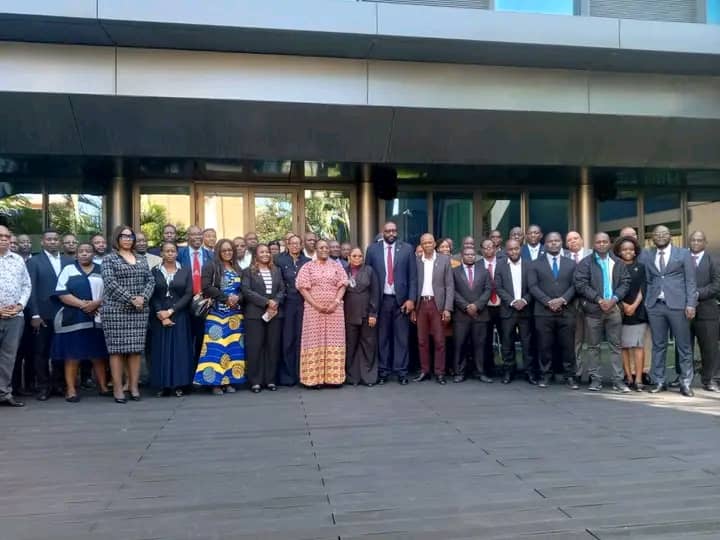
By Jeremiah Gora
BEIRA, Mozambique – A well-functioning transport infrastructure network is essential to sustaining Zimbabwe’s logistics ecosystem and unlocking regional trade, Permanent Secretary in the Ministry of Transport and Infrastructural Development Engineer Joy Pedzisai Makumbe has said.
Speaking during the opening of the Zimbabwe-Mozambique Joint Border Committee (JBC) meeting in Beira today, Eng. Makumbe said Government was prioritising strategic transport infrastructure investments and border modernisation to improve the movement of people and goods along the Beira Corridor.
“A well-functioning transport infrastructure network is essential to sustaining our logistics ecosystem,” she said.
She revealed that Government had approved a Public-Private Partnership (PPP) between the Ministry of Transport and Infrastructural Development and the Forbes Border Consortium to upgrade Forbes Border Post under a Design-Build-Finance-Operate-Maintain (DBFOM) model.
“Under this arrangement, the private partner designs, builds, finances, operates, and maintains the border post for the duration of the concession, ensuring performance standards and lifecycle quality,” said Eng. Makumbe.
She said preliminary civil works, including the clearing and fencing of a temporary truck staging area, had already been completed to improve traffic flow, queue management and congestion control while awaiting final approvals for the main project.
“The upgrading of Forbes Border Post remains a top priority, with far-reaching benefits for trade, tourism, and regional integration,” she said.
Eng. Makumbe said Government had also completed the rehabilitation of the Harare-Masvingo-Beitbridge Highway and was now focusing on upgrading the Harare-Chirundu, Harare-Nyamapanda and Bulawayo-Victoria Falls roads, as well as constructing interchanges in major cities to improve regional connectivity.
She described the Joint Border Committee as a critical platform for addressing persistent challenges affecting the Forbes-Machipanda Border Post, including congestion, infrastructure limitations, fragmented procedures, security risks and weak regulatory harmonisation.
“These challenges are systemic. They cannot be resolved in isolation. They require coordinated, cross-border solutions — and this is precisely why the JBC mechanism is so important,” she said.
Eng. Makumbe said Zimbabwe and Mozambique shared a strategic partnership anchored on geography, trade and a common vision of regional integration.
“Our gathering today is a clear demonstration of our shared commitment to strengthening regional connectivity, improving corridor performance, and ensuring that the movement of people and goods between our two nations is safe, predictable, and seamless,” she said.
She said officials from both countries had already drafted the Terms of Reference for the Joint Border Committee following a meeting in Mutare in March this year, with support from TradeMark Africa, to strengthen institutional coordination and improve operational efficiency at the Forbes-Machipanda Border Post.
Eng. Makumbe urged delegates to focus on harmonising border procedures, strengthening coordinated inspections, enhancing infrastructure planning, improving safety and compliance, and deepening cooperation among transport, customs, immigration, police and standards authorities.
“What matters is implementation — consistent, coordinated, and measurable implementation that delivers real improvements on the ground,” she said.
She said efficient transport corridors were essential for reducing the cost of doing business, attracting investment, creating jobs and advancing regional integration under the African Continental Free Trade Area (AfCFTA), the Tripartite Free Trade Area and the Southern African Development Community (SADC) industrialisation agenda.
TheVhayeya.com to the world🌍
