



By Jeremiah Gora
The Minister of Transport and Infrastructural Development, Honourable Advocate Felix T. Mhona, has said the time has come for African countries to build modern, resilient and efficient aviation infrastructure while leveraging advances in information and communication technologies to accelerate continental air transport liberalisation and integration.
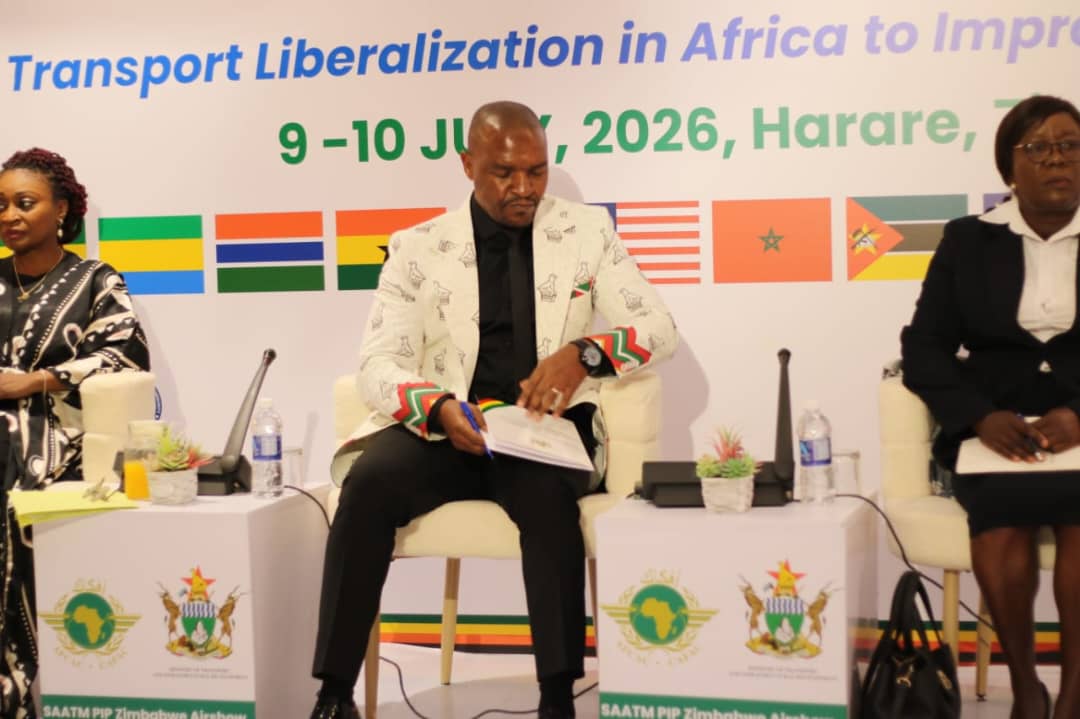
Addressing delegates at the Single African Air Transport Market (SAATM) Pilot Implementation Project (PIP) Airshow in Harare today, Hon. Mhona urged African governments, aviation regulators and industry stakeholders to move beyond rhetoric and take coordinated action to transform the continent’s aviation sector in line with the African Union’s Agenda 2063.
“The time is now for us to build modern, resilient, and efficient aviation infrastructure while leveraging advances in information and communication technologies,” said Hon. Mhona.
He said the full implementation of SAATM remains critical to Africa’s socio-economic transformation, as it will remove restrictions on air transport, improve connectivity, stimulate trade and tourism, and support the African Continental Free Trade Area (AfCFTA).
Hon. Mhona revealed that Zimbabwe is reviewing all its Bilateral Air Services Agreements (BASAs) with SAATM member states to ensure compliance with the Yamoussoukro Decision, a move aimed at eliminating unnecessary restrictions and enabling African airlines to establish more direct routes.
“Zimbabwe is currently reassessing all BASAs with the SAATM Member States, to ensure they are in compliance with the Yamoussoukro Decision,” he said.
He noted that the 2025 SAATM Implementation Report shows intra-African connectivity increasing from 14.5 percent in 2021 to 23 percent in 2025, largely driven by the expanded use of Fifth Freedom Traffic Rights.
According to the Minister, Zimbabwe has already implemented all eight SAATM Concrete Measures following its signing of the Solemn Commitment to implement SAATM in 2022 and continues to negotiate agreements aligned with the continent’s aviation liberalisation agenda.
Hon. Mhona said aviation liberalisation must be supported by adequate infrastructure, highlighting Zimbabwe’s investment in the rehabilitation and expansion of Robert Gabriel Mugabe International Airport, Joshua Nkomo International Airport and Victoria Falls International Airport through Public-Private Partnerships.
He said the Robert Gabriel Mugabe International Airport now has the capacity to handle about 6.5 million passengers annually, up from approximately two million.
The Minister added that Zimbabwe has modernised its airspace management systems through the installation of a Secondary Surveillance Radar System, upgraded Air Traffic Control systems and the implementation of an Aeronautical Message Handling System to enhance aviation safety and operational efficiency.
Calling on African states that have not fully embraced SAATM to do so, Hon. Mhona said barriers such as protectionism, market access restrictions and non-tariff impediments continue to hinder the growth of African aviation.
“The time has come for us to dismantle the barriers that impede its success, including excessive protectionism, market access restrictions, and non-tariff impediments affecting the growth of African aviation,” he said.
He urged delegates attending the Airshow to focus on practical solutions that will accelerate implementation of SAATM.
“As we deliberate during this Airshow, let us not conduct business as usual. Rather, let us critically assess our progress and identify areas which require urgent attention,” Hon. Mhona said.
The SAATM Pilot Implementation Project Airshow brought together ministers, aviation experts, regional economic communities and industry stakeholders from across Africa to explore ways of accelerating the liberalisation of African air transport and improving continental connectivity.
